
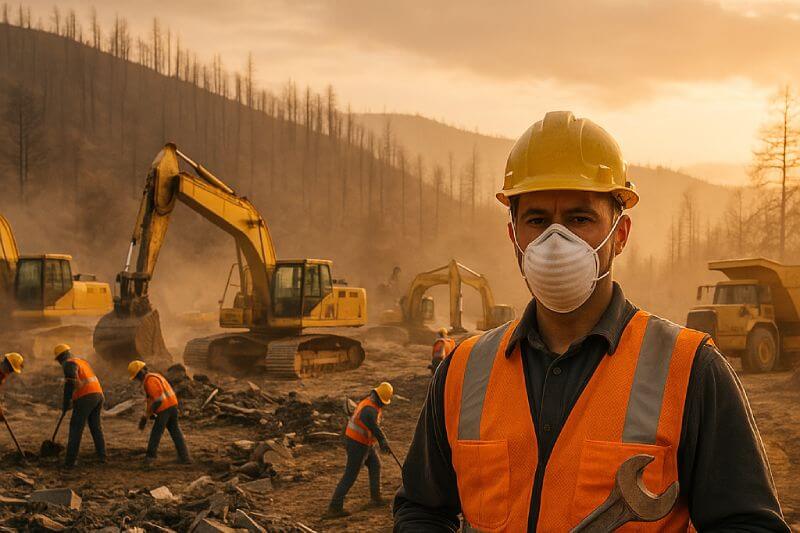
The 2025 Sierra Fires were among the most destructive wildfires California has seen in more than a decade. Spanning multiple counties across the Sierra Nevada region, the fires damaged hundreds of structures, compromised critical roadways, and left entire communities isolated from essential services.
When state emergency agencies activated private-sector support, Constructors was one of the first heavy-equipment partners called to assist. With rugged terrain, unstable slopes, and hazardous debris fields, this operation required rapid mobilization, precision engineering, and highly trained operators working under extreme conditions.
This case study highlights how Constructors supported the recovery mission—restoring access routes, stabilizing burned hillsides, and helping communities begin the difficult process of rebuilding.
The Challenge: Rebuilding in a High-Risk, Post-Fire Environment
Post-wildfire environments create a unique set of construction challenges:
- Weakened soil and landslide risk
- Collapsed bridges and damaged roadbeds
- Hazardous debris, including metal, toxic ash, and unstable trees
- Access limitations for equipment mobilization
- Temperature spikes and heavy smoke affecting operators
The 2025 Sierra Fires added another complexity:
entire mountain passes had been rendered inaccessible, blocking relief crews and emergency convoys.
Constructors’ mission was clear:
restore safe access to affected communities—fast.
Phase 1: Rapid Assessment & Equipment Deployment
Within 24 hours of receiving the emergency request, Constructors deployed:
- 11 excavators (CAT 320–349 class)
- 6 dozers (D6 & D7 for slope stabilization)
- 9 haul trucks
- 4 motor graders for road reconditioning
- Specialized forestry attachments for burnt tree removal
- 2 crane units for bridge component clearing
Each unit was paired with certified operators trained in:
- Wildfire-zone equipment operation
- Hazard identification
- Emergency traffic control
- Steep-slope maneuvering
A mobile command trailer and service trucks were dispatched to maintain uptime in remote sectors.
Phase 2: Clearing Access Routes for Emergency Services
The first 72 hours were dedicated to restoring highway and backroad access, a critical step for enabling:
- Fire crews
- Medical teams
- Utility restoration workers
- Evacuation and return convoys
Key tasks included:
🔹 Removing collapsed trees and debris
Burned forests left thousands of unstable tree trunks. Excavators with grapples and saw attachments worked continuously to clear safe travel lanes.
🔹 Stabilizing shoulder failures
Dozers and graders rebuilt shoulders and drainage paths to prevent vehicles from sliding on weakened terrain.
🔹 Rebuilding critical access points
One mountain pass required full-day crane operations to remove twisted guardrails and bridge components obstructing the route.
By day five, 80% of primary access had been restored.
Phase 3: Slope Stabilization & Erosion Control
After wildfires, even light rainfall can trigger catastrophic landslides. Constructors partnered with geotechnical engineers to reinforce high-risk slopes using:
- Dozer benching
- Boulder placement
- Temporary retaining walls
- Hydromulch and erosion blankets
- Strategic drainage channeling
Over 19 hillside sections were stabilized—preventing future damage during the winter storm season.
Phase 4: Community Support & Structural Cleanup
Beyond infrastructure, Constructors supported local communities by:
- Assisting homeowners with debris removal
- Demolishing unsafe structures
- Clearing foundations for rebuilding
- Helping restore private driveways and ranch access roads
A dedicated team worked directly with local fire departments to remove burned vehicles, propane tanks, and hazardous metal debris.
Operator Safety in Extreme Conditions
Working in post-fire zones presents numerous safety hazards:
- Unstable root systems
- Hidden hot spots
- Toxic particulates in the air
- Equipment overheating risks
Constructors enforced strict protocols:
- Rotating operators every 2 hours
- On-site cooling tents
- Continuous air-quality readings
- Remote telematics monitoring for engine heat and pressure
These safety measures kept the entire fleet and workforce operational for the full recovery duration.
Results: Restoring Hope and Infrastructure
In just 14 days, Constructors achieved major recovery milestones:
- 47 km of roadway reopened
- 19 slopes stabilized
- 220+ debris loads removed
- 9 bridges and creek-crossings cleared
- Dozens of homes given direct rebuilding access
More importantly, communities that were once cut off were reconnected to essential resources, enabling residents and first responders to begin rebuilding lives and livelihoods.
Looking Ahead: Strengthening Future Response Capabilities
The 2025 Sierra Fires highlighted the increasing importance of:
- Rapid equipment mobilization
- Specialized wildfire-zone training
- Data-driven hazard mapping
- Coordinated public–private recovery frameworks
Constructors is now investing in:
- More Tier 4 Final and hybrid dozers for sensitive environments
- Expanded forestry and fire-recovery attachments
- Enhanced operator wildfire training programs
- Faster-response logistics teams
As climate-related disasters continue to intensify, constructors capable of responding quickly with the right equipment and expertise will be essential to California’s future resilience.
Conclusion
The 2025 Sierra Fires left a trail of destruction—but they also showed what coordinated recovery efforts can achieve.
Constructors played a central role in reopening critical routes, protecting against erosion, and assisting communities on the road to reconstruction.
This case study stands as a testament to the power of skilled operators, durable machinery, and unwavering commitment in times of crisis.